

What Jensen Huang’s return to Nvidia teaches us about the responsibility of leaders to build institutions that can survive them.
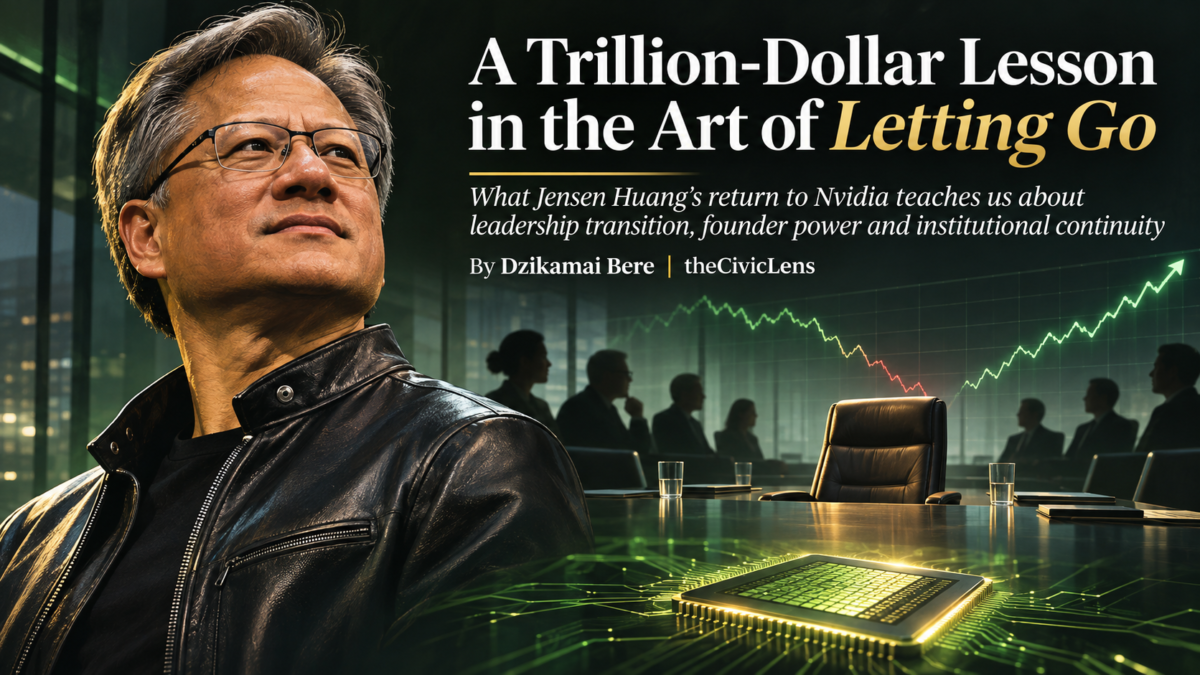
On Monday, 23 November 2026, the return of one man to a leadership position added approximately $952 billion to the market value of a company. Jensen Huang, the co-founder of Nvidia, was back at the helm of the technology giant he had helped build over three decades.
By the close of trading in New York, Nvidia shares had risen by 31.48 per cent to $165.05, bringing the company’s market capitalisation to approximately $3.98 trillion. According to MarketWatch, the increase represented the largest single-day gain in market value by an American company.
As someone who has spent considerable time reflecting on the relationship between leaders and the institutions they build, I find this development both extraordinary and unsettling.
Extraordinary because it demonstrates the immense value that an individual can bring to an institution. Unsettling because it invites us to consider what happens when so much confidence in an institution becomes concentrated in the person leading it.
There is much to celebrate about Jensen Huang’s contribution to the world. There is equally much to learn from the eleven days during which Nvidia had to contemplate a future without him.
Eleven days without Jensen
On 12 November 2026, Nvidia announced the resignation of Jensen Huang as president, chief executive officer and member of its board of directors. A regulatory filing confirmed that the board had accepted his resignation the previous day.
Colette Kress, who had served as the company’s chief financial officer since 2013, was appointed interim chief executive. Harvey C. Jones became Nvidia’s first-ever chairperson of the board. A process to identify a permanent chief executive was announced.
This was no ordinary retirement. Huang’s departure came amid reports concerning his personal conduct and questions relating to national security. The board had constituted an independent committee to investigate reports that he had been targeted by a foreign intelligence effort.
Nvidia’s shares, which had closed at $173.73 on 11 November, fell to an intraday low of $148.80 the following morning before recovering to close at $166.19. At its lowest point that morning, approximately $600 billion in market value had disappeared relative to the previous day’s closing valuation.
By Friday, 20 November, the shares had closed at $125.53.
Then came the reversal. On 22 November, the board unanimously reinstated Huang, announcing its decision the following morning. The board said it had reached its decision after discussions with Huang and receiving input from senior levels of the United States government. It also confirmed that its independent investigation would continue.
The markets responded enthusiastically.
The fluctuations in Nvidia’s valuation represent changes in the market’s assessment of the company, rather than equivalent amounts of cash leaving or entering its bank accounts. Neither can we attribute the entire decline to Huang’s departure. The broader technology sector was experiencing significant volatility, while concerns about artificial intelligence investment, export restrictions and regulatory investigations were also influencing investors.
Nevertheless, the events offer an unusual opportunity to examine the relationship between the value of a leader and the durability of the institution that leader has built.
The paradox of successful leadership
Jensen Huang’s contribution to Nvidia is difficult to overstate. Together with his fellow founders, he established a company in 1993 that would evolve from a business associated with computer graphics and gaming into one of the central institutions of the global artificial intelligence revolution.
The development of CUDA in 2006 helped open the possibilities of parallel computing beyond conventional graphics applications. Years of investment in accelerated computing positioned Nvidia to benefit from technological developments whose full commercial significance was not immediately apparent to much of the world.
Such achievements require imagination, conviction and the courage to invest in a future that others may not yet see.
Many institutions owe their existence to individuals of this nature. They survive their difficult formative years because someone believes in an idea long before there is sufficient evidence to justify that belief. Someone gathers the first team, cultivates the first relationships and accepts responsibility when failure appears more probable than success.
But successful leadership eventually creates a different assignment for the leader.
In his 2003 study, Founder-CEO Succession and the Paradox of Entrepreneurial Success, Noam Wasserman examined the succession histories of 202 internet companies. He found that achieving important entrepreneurial milestones could significantly increase the likelihood of a founder being replaced as chief executive.
The success of the founder creates an organisation whose leadership requirements may evolve beyond those of its founding moment.
This does not necessarily mean that the founder has become incapable of leading. It means that the institution has changed, and the manner in which it is led must also change.
The challenge for successful founders is to recognise when the leadership practices that gave birth to an institution need to make way for the practices that will sustain it.
What was once necessary concentration of authority can become institutional dependency. What was once a valuable personal relationship can become an impediment to institutional continuity. What was once the founder’s exceptional ability to make decisions can become the reason why everyone else struggles to make them.
The same qualities that make us successful in one season of leadership may undermine the sustainability of our achievements in another.
Nvidia did not stop being Nvidia
There was another development during Huang’s absence that deserves considerably more attention.
On 17 November, under the interim leadership of Colette Kress, Nvidia announced its financial results for the third quarter of fiscal year 2027.
The company reported revenue of $115.8 billion, representing an increase of 103 per cent compared with the corresponding period the previous year. Net income stood at $65.3 billion.
These were results for the quarter ending 25 October, before Huang’s resignation. They cannot reasonably be presented as evidence of what an eleven-day interim administration achieved independently of its predecessor.
But they direct our attention towards something that is easily obscured when the story of institutional success is told entirely through the accomplishments of one person.
Behind Jensen Huang stands Nvidia.
There are engineers, researchers, finance professionals, executives, developers and commercial partners. There are accumulated bodies of knowledge, intellectual property, production arrangements, technological capabilities and organisational systems that have been developed over decades.
Huang’s extraordinary contribution has been made possible, in part, by his ability to assemble and mobilise these capabilities.
Yet an institution must develop two forms of continuity. It must develop the operational capacity to continue its work beyond its founder, and it must cultivate confidence among its constituencies that it possesses such capacity.
An institution may have highly competent people whose competence remains largely invisible to those outside it. It may have a functioning executive team while its stakeholders continue to associate every important achievement with the chief executive.
When this happens, the institution’s capacity may be more widely distributed than its legitimacy.
For leaders, the responsibility is therefore greater than preparing people to take over. We must also prepare the constituencies of the institution to receive them.
The art of letting go is practised every day
In The Art of Letting Go series, I make the argument that leadership transition should never be reduced to the moment when one person leaves office and another takes over. Leadership transition begins in the everyday exercise of leadership. Every meeting that a leader chairs presents an opportunity to develop the leadership of others or reinforce their dependence on the person chairing it. Every important institutional relationship presents an opportunity to extend trust to other colleagues or consolidate that trust around one individual. Every difficult decision presents an opportunity to cultivate judgment in emerging leaders or teach them that their responsibility ends where the incumbent’s authority begins.
Over time, these choices accumulate. They determine the kind of institution that will exist when the leader is no longer available.
In the civic sector, where I have spent much of my professional life, we sometimes encounter organisations in which the departure of an executive director threatens relationships with donors, partners and communities that have taken years to develop.
The funding agreement may be with the organisation, but the confidence of the funding partner rests with the individual. The organisation may have a leadership team, but the important relationships remain exclusively in the hands of its executive director.
Sometimes we contribute to this dependency without realising it. We attend every important meeting ourselves because we believe we can secure the best outcome. We retain control over consequential decisions because we have the experience to make them. We speak on behalf of the institution because we have established credibility.
And indeed, these choices may produce excellent immediate results.
But what happens when we are no longer available to attend those meetings, make those decisions or speak on behalf of the institution? The responsible leader must occasionally be willing to sacrifice the convenience of personal intervention for the long-term benefit of institutional learning. This is why I place such emphasis on leadership accompaniment. We must create opportunities for colleagues to carry consequential responsibility, exercise judgment, make mistakes, learn from them and acquire the confidence of those whose relationships sustain the institution.
Accompaniment has failed when the person being accompanied becomes increasingly competent but remains permanently dependent on the approval of the person accompanying them. We must develop leaders who can hear our advice, appreciate our experience, understand our reasoning and still arrive at a different conclusion.
That is how judgment becomes an institutional resource.
Preparing an institution for our absence
One of the most useful comparisons with Nvidia can be found in the leadership history of Apple.
On 17 January 2011, Steve Jobs announced that he would take medical leave. He entrusted Tim Cook with responsibility for Apple’s day-to-day operations while retaining involvement in major strategic decisions. When Jobs resigned as chief executive on 24 August 2011, he recommended that the board implement its succession plan and appoint Cook as his successor.
Fifteen years later, on 20 April 2026, Apple announced another leadership transition. Cook would hand over executive leadership to John Ternus on 1 September 2026. At the time of the announcement, Apple reported that its market capitalisation had grown from approximately $350 billion to $4 trillion during Cook’s tenure.
The circumstances at Apple and Nvidia are fundamentally different. Jobs’s medical leave cannot be equated with the crisis surrounding Huang’s departure. Nor should Apple’s commercial success be attributed solely to its succession arrangements. What Apple nevertheless demonstrates is that an institution built by an exceptional founder can continue to innovate, grow and renew itself under successive generations of leadership.
For founders and boards, there is a practical lesson here. We should deliberately create occasions on which institutions experience the absence of their principal leaders while those leaders are still available to support the learning process. A sabbatical, an acting appointment or a period of genuinely delegated leadership can reveal more about institutional preparedness than a succession policy that has never been tested.
Who makes decisions when the incumbent is unavailable? Who receives the telephone calls from important partners? What happens when an unexpected problem emerges? Does the leadership team have the authority to respond, or must it interrupt the incumbent’s absence to obtain permission?
The answers tell us something about the institution we have built.
It is better to discover these vulnerabilities while we have the opportunity to address them than to discover them in the middle of a leadership crisis.
The responsibility of the board
The lessons of Nvidia’s experience extend beyond Jensen Huang.
When the board announced his reinstatement, it expressed confidence in his ability to lead. It also confirmed that the independent investigation would proceed and that Huang had undertaken to cooperate.
A separate committee responsible for national security and export control oversight had already been established. The company also announced that it would recruit a chief compliance officer reporting to its nominating and corporate governance committee.
These developments are important. The restoration of market confidence cannot substitute for the completion of an independent accountability process.
A board must be capable of recognising the exceptional contribution of its chief executive while maintaining the independence necessary to hold that executive accountable.
If the economic or reputational value of a leader becomes a reason why ordinary accountability mechanisms cannot operate, the institution has acquired a vulnerability of considerable consequence.
The same applies to civic organisations. A board that is unable to confront a successful executive director because that person is indispensable to the organisation’s fundraising or public credibility is a board whose authority has become conditional.
Boards must therefore invest in two forms of succession preparedness. The first is the ability to respond immediately when a leader becomes unavailable. The second is the deliberate development of a leadership pipeline for the institution’s next season.
The person capable of providing continuity during an emergency need not necessarily be the person best suited to lead the next decade of institutional development.
Colette Kress deserves recognition for accepting responsibility during an extraordinarily difficult period. Institutions require people willing to carry the burden of uncertainty when circumstances demand it. Their contribution should never become invisible simply because the previous leader has returned.
The opportunity of a second season
Of course, Nvidia can survive without Jensen Huang. But the quality of that survival will depend, among many other factors, on how Jensen Huang exercises leadership every day between now and his eventual departure.
His return presents him and the board with an opportunity that many leaders never receive: the opportunity to reflect on an institution’s experience of their absence while they are still in a position to influence its future.
There is no contradiction between continuing to benefit from Huang’s exceptional leadership and preparing Nvidia for the day when that leadership will no longer be available.
His present value to Nvidia may indeed be immense. His future legacy will be strengthened if he uses that value to build the authority, credibility and capacity of those who will come after him.
For every founder, whether of a technology company, a civic movement, a charitable organisation or a family business, the same invitation exists.
We can build institutions that flourish because we are present and collapse because we are absent. Or we can build institutions that flourish through our contribution and continue flourishing through the contributions of others.
Both outcomes are shaped by the leadership choices we make today.
The world has celebrated the return of Jensen Huang to Nvidia. I hope that when the day comes for his eventual departure, the world will have another reason to celebrate: that this extraordinary leader has built an institution so rich in leadership, so confident in its people and so secure in its purpose that it can receive his departure with gratitude rather than fear.
That will be an achievement worth considerably more than a trillion dollars.
A Trillion-Dollar Lesson in the Art of Letting Go
