“It is not the critic who counts; not the man who points out how the strong man stumbles, or where the doer of deeds could have done them better. The credit belongs to the man who is actually in the arena, whose face is marred by dust and sweat and blood…”
— Theodore Roosevelt, Citizenship in a Republic (23 April 1910)
“Young man,” Abel’s voice came through the phone, “You need to report for duty. How can I help?”

That call was the beginning of an accompaniment process that brought around me a group of nearly a dozen seasoned civic leaders, offering to walk with me on the journey to rebuild the people’s movement at ZimRights. That day, I went to Abel’s office and we talked for hours. I recall it vividly because it changed the course of my leadership journey. We sat by the swimming pool as he worked through piles of papers, yet remained fully present to my concerns.
Abel and I go a long way. He was my first employer in civil society after I left the bench. A transition from government into civil society is rarely smooth. It is a closed space, often guarded by a justified fear of infiltration. Coming from the judiciary, I had no track record in the “streets.” But Abel took a gamble on me.
I had left the judiciary in 2008 following a protracted industrial action by Magistrates and Prosecutors. Some members of the movement allegedly received bribes to break the protest and return to work without the reforms we demanded. I decided I could not go back. I was ready to join civil society, but I wasn’t sure of my place until I met Arnold Tsunga, a living legend in civic leadership, at my brother’s birthday party. After I gave a short speech, Arnold approached me and said, “I think you should join us. You will make a difference.”
When Arnold speaks, you listen. Yet, I hesitated. I returned to Bulawayo where I was stationed at the Mpopoma (Western Commonage) Magistrates Court. The strike continued. I was deep in the struggle for an independent judiciary, writing articles under a pseudonym to push for reform.
In February 2008, a meeting at Tredgold poured cold water on our momentum. The resolution was to return to work without a commitment to reform. That was the day I made up my mind. I loved the law and the bench, but I would no longer hide. I would not write under a pseudonym or sneak into a protest hoping no one would recognize me. I wrote my resignation, met my boss, and told her I wanted to move closer to the action. I believed I could serve the same goals of justice from a different station. She blessed my decision, and I took off my judicial robes and headed to the streets of Harare.
I reached out to different civil society organizations but no one knew me. People take time to trust. My judicial activism had been performed underground. 2008 was the period when Morgan Tsvangirai defeated Robert Mugabe. Civil society was pushing the coalition government to investigate past atrocities as change seemed inevitable. This was a conversation I wanted to be part of, but the space was closed to outsiders, especially if you appeared to be coming from government.
One of the organizations I approached was the Zimbabwe Peace Project (ZPP) then headed by Jestina Mukoko, doing some phenomenal work on documenting human rights violations. They did not even respond to me. I reminded Jestina of this story the day I was elected to Chair ZPP and we laughed about it. Jestina does not have a good memory of Magistrates. The other organization I reached out to was ZimRights, then under the leadership of Dzikamai Machingura. And they turned me down. I later met Dzikamai at a human rights event in 2010 and reminded him that he had turned down my application. He joked that he did not want to be accused of nepotism since I was also ‘a Dzikamai’.
It was not until June 2009 that Brian Penduka, then Programmes Manager at the Zimbabwe Human Rights NGO Forum (the Forum), called me to his office to discuss how the Forum could benefit from my writing abilities.
I reported at Eastgate Building where the Forum was headquartered. Brian briefed me on an ambitious transitional justice outreach that the Forum was preparing to launch and asked if I would be interested in being part of it. Morgan Tsvangirai and Robert Mugabe were about to sign the Global Political Agreement (GPA) to form the new coalition government. The Forum was leading a consortium of CSOs in thinking how to place transitional justice on the agenda of the new government. The political elites on both sides of the political divide had agreed to ignore transitional justice and so the Forum wanted to mobilize communities to gatecrash the party and make transitional justice an issue. I loved the idea.
That afternoon, Brian introduced me to Abel Chikomo. A busy man as usual but very friendly and warm. They told me that they were hosting a training on transitional justice for community facilitators. They loved my writing and wanted me to attend the training to see if this was something I wanted to be involved in. I attended the training at the Holiday Inn. In August 2008, the “Taking Transitional Justice to the People” Programme was launched, and I was engaged to attend all the outreach meetings and write the reports. I was engaged for what was supposed to be a six-month stint; it turned into ten phenomenal years of high-impact campaigning.
When I look back on that journey, I am deeply grateful to the team at the Forum—especially Brian and Abel—for facilitating my transition into a space where I believed I could serve better. It was not easy. I had no track record, and I was coming from an institution they had every reason to be cautious of. Yet, they chose to say, ‘Let’s give this young man a chance.’ That was my first true interface with civic leadership, and their mentorship laid the foundation for my entire leadership philosophy. Abel’s predecessor, the amazing Eileen Sawyer, had stepped down as Executive Director but remained as a consultant. Because the Forum valued my reports on the transitional justice outreach, Eileen took me under her wing. She was a master of the craft. Together, Brian, Abel, and Eileen became a formidable mentorship crew, teaching me that the pen is only as powerful as the clarity of the purpose behind it.
“Don’t write like a lawyer,” Eileen used to say. And that is a great lesson for every lawyer.
But the greatest leadership lesson came to me in 2010, when we were implementing the second phase of the Taking Transitional Justice to the People Outreach. I was arrested with a colleague in Machipisa while we were carrying out a transitional justice survey. I worked with a competent team of eight researchers. The project touched a raw nerve with its quest to gauge public opinions and perceptions on past human rights violations that included Gukurahundi.
Abel showed leadership when he turned up at Harare Central Police Station’s notorious Law and Order section. He introduced himself as the Director at the Forum. He told the police that he was the one who had sent us to do the work we were doing. For that reason, he demanded that we should be released and that he was prepare to be arrested in our place. The police complied. They released us, arrested Abel, and charged him with running an illegal organization in a case that led to the protracted prosecution of the Forum. Abel was later acquitted of the charges by the Magistrate Court after international condemnation of what was clearly an attempt to silence civil society and sabotage the Forum’s transitional justice programme.
But for me, that was a moment of profound leadership. When a leader leads selflessly, caring more for his team, he wins more than just commitment. He wins loyalty and trust. This is what John C. Maxwell calls High Road Leadership: valuing people and placing them above your own personal agenda. When you lead with love, care, and compassion, people don’t follow you because of your title. They follow you because of what you represent to them. Even when you are no longer their ‘boss’, they still believe in you and therefore continue to follow you. The relationship becomes deeper than the positions and the titles.
That is why, years later, after I resigned from ZimRights on the day I was supposed to start work, and Abel called and said, ‘How can I help?’, I believed he genuinely cared for me and would be able to help.
I went to his office and we spoke. There was no easy solution. We were not going to rush this. As he worked on his own pile of work, we reflected on our time at the Forum and the good work we had achieved there. But he said I had grown now and needed to move. We unpacked the situation at ZimRights. What had gone wrong there and can this be fixed? We were teetering on the thin line between hope and despair. But what made the day, and later history, was Abel’s reflection on ZimRights as the first post-independence indigenous grassroots human rights movement for Zimbabwe and what it meant for the people of Zimbabwe. Before ZimRights was formed in 1992, all other movements that were active in Zimbabwe were mainly international. ZimRights would be the first to be formed by locals. At the core of that movement was that human rights must not be abstract or a conversation for the elite. Human rights are not a foreign agenda. Human rights must be an everyday people’s agenda. That is why ZimRights was formed and over three decades, that determination had held the movement together.
“This is not an institution that we must lose, if we can help it.”
The framing of the leadership moment shifted. I was being invited to serve the people of Zimbabwe. It was like Abel was saying to me, “If you were entering this space thinking like an employee, asking more what you will get, than what you must give, you must de-role from that.”
“If you are as well coming in thinking like a CEO, thinking this is your time to eat, again, you must shift from that.”
Abel did not say these words, but he made sure I heard them.
“But we are not saying you must starve. We can find ways, but what matters for this role for now is that it is a national service. You are serving the people’s movement.”
“I can’t think of anyone who can do this better than you,” Abel said.
I recall this conversation because it connected me with my transition from the judiciary. That is the day I asked myself, “Why am I in this arena?” I had made a commitment in 2008 to hang up my judicial robes and join the streets. I was being called to make another commitment to serve.
We will be there to help you. That was Abel’s message. Simple but profound.
I let go of my expectations of what a CEO role in a national organization would mean. I was not going to be an everyday leader. I was not leading in plenty. I was going to lead in the wilderness. My mission was to turn around the people’s movement. And it was going to cost me big time. But as long as I had that clarity, and the support of the people I trusted and who trusted me, I was confident that the job would be done.
And so, I embraced my why. And that gave me wings.
If you are reading this, and you are a leader, and you have not had this reflection, you need to start right now. Every leader, in their arena, you must know that you have a specific assignment. You must know your assignment and dedicate yourself to accomplishing it. You will be guided by the law of victory. Your assignment must be clear. It must be so clear that when you have accomplished it, there is no guesswork. It must be very clear to you and everyone that the job is done. When the job is done, you have to move on before you start undoing your good work. Knowing this from day one is what allows you to watch carefully the transition window, so that you do not miss it.
Many leaders have made this mistake, only to begin undoing their good work.
After ZimRights announced that I will me making a transition, one leader said to me, “Why are you leaving now? Isn’t this your time to eat?” My answer was, “No, this is my time to go.”
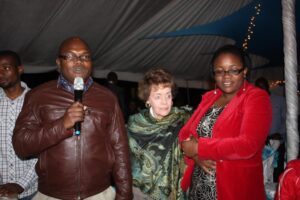
Picture: On the left is Abel Chikomo, my former boss at the Forum. On the right is Susan Mutambasere, former colleague at the Forum. At the center is the late Eileen Sawyer – the woman who taught me to write well. Partially cut at the left – Dr. Prosper Maguchu. This was at our wedding, and they were giving a speech. This moment represents for me ‘The Art of Leadership Accompaniment’. That was 4 August 2012 at Lake Chivero, Harare Safari Lodge