
“Cook asked whether he and the other top managers should leave. Jobs paused for more than 30 seconds before he decided they should,” Walter Isaacson writes in the biography Steve Jobs.
Once the room had been cleared of everyone except the six outside directors, Jobs began reading aloud from a letter he had dictated and revised over the previous weeks.
“I have always said if there ever came a day when I could no longer meet my duties and expectations as Apple’s CEO, I would be the first to let you know,” it began. “Unfortunately, that day has come.”
The letter was simple and direct, only eight sentences long. In it, he suggested that Cook replace him and offered to serve as Chairman of the Board.
“I believe Apple’s brightest and most innovative days are ahead of it, and I look forward to watching and contributing to its success in a new role.”
There was a long silence.
Al Gore, one of the board members, was the first to speak. He listed Jobs’ accomplishments during his tenure. Millard Drexler added that watching Jobs transform Apple was “the most incredible thing I have ever seen in business.” Arthur Levinson praised Jobs’ diligence in ensuring a smooth transition. Bill Campbell said nothing, but there were tears in his eyes as the formal resolutions transferring power were passed.
As he prepared to leave, the board members gathered around him and embraced him.
It is now fifteen years since Steve Jobs stepped down, paving the way for Tim Cook. And the script is turning again.
On 20 April 2026, Apple announced that Tim Cook will be stepping down as CEO, with John Ternus, Senior Vice President for Hardware Engineering, taking over as CEO on 1 September 2026. In a statement, Apple said the transition, approved unanimously by the Board of Directors, follows a thoughtful and long-term succession planning process.
Arthur Levinson, who served on the board during Jobs’ time and has been Apple’s non-executive chairman for the past fifteen years, will become lead independent director on 1 September 2026. Ternus will join the board of directors on the same date.
“Tim’s unprecedented and outstanding leadership has transformed Apple into the world’s best company. He has introduced groundbreaking products and services time and again, and his integrity and values are infused into everything Apple does,” said Levinson. “On behalf of the entire board, we are incredibly grateful for his contributions to Apple and to the world.”
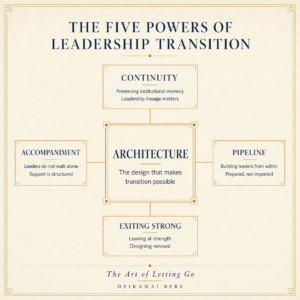
The Apple succession story offers many lessons for leaders. I share here only five.
a. The power of architecture.
There are striking similarities in how Steve Jobs stepped down and how Tim Cook is stepping down. When Jobs stepped down, he became Chairman of the Board. We see a similar pattern as Cook transitions to Executive Chairman. This speaks to a guided transition. Apple is not leaving anything to chance. It has created a transition architecture that ensures continuity, oversight, and support for the incoming leader. The company has also indicated that Cook will continue working closely with Ternus to ensure a smooth transition.
b. The power of continuity.
When one studies Apple’s transitions, a pattern emerges. The same names continue to play key roles. Tim Cook, John Ternus, and Arthur Levinson are part of a leadership lineage that traces back to Steve Jobs. This continuity preserves institutional memory and stabilises leadership transitions. The leadership talent is not lost. It remains within the ecosystem.
c. The power of an internal leadership pipeline.
The Cook–Ternus transition is the second major transition in which Apple has chosen an insider as CEO. This is not by chance. Apple has invested deliberately in developing internal leadership. When the time for transition comes, the next leader is already within the system, prepared through experience and exposure. Research supports this. Organisations that build strong internal leadership pipelines are more likely to sustain long-term performance, as noted by Jim Collins and his team in Built to Last.
d. The power of accompaniment.
There is a strong tradition of leadership accompaniment at Apple. As Cook steps down into the role of Executive Chairman, and Levinson transitions into lead independent director, the structure ensures that leadership remains supported. The outgoing leaders do not disappear. They reposition. In doing so, they continue to provide guidance and stability. No leader is left to walk alone.
e. The power of checking out strong.
We see Cook stepping down at a time when Apple is performing exceptionally well. While Jobs stepped down primarily due to health reasons, the organisation he left behind was also strong. This is a critical lesson. Leaders do not step down only when they have failed. They step down to catalyse renewal and future growth. Under Cook’s leadership, Apple grew from a market capitalisation of approximately $350 billion to $4 trillion. Annual revenue nearly quadrupled, from $108 billion in 2011 to over $416 billion in 2025. In many contexts, such results would encourage a leader to stay indefinitely.
We live in a world where many organisations struggle with succession planning and leadership transition. Without intentional design, organisations move from one leader to another without continuity. Some collapse in the process. Others shrink into personal projects.
The lessons from Apple’s succession journey offer a different path. They show that leadership transition, when designed well, strengthens institutions rather than weakens them.
How leaders choose to design and embrace renewal will determine whether their institutions endure.
Leading with impact. Leaving with dignity.
That is the art of letting go.
________________________________________________________________________________________
Steve Jobs ‘ transition story taken from Walter Isaacson’s book Steve Jobs. The Tim Cook transition story was taken from CNBC and Businesswire